

KEY TAKEAWAYS
- Starting a business takes time, money, and passion.
- Inadequate market research leads to a mismatch between products or services.
- When working in saturated niches you may face stiff competition.
- Ineffective financial management leads to the rapid depletion of funds.
- Get a clear picture of the market and create a robust business plan.
- Come up with a user-friendly website design and optimize for mobiles.
About 90% of startups fail—it stings, but it’s a reality plenty of entrepreneurs face in the world of e-commerce.
In the first year alone, 10% of new companies shut down, and the number rises to 70% in the second to fifth years. And it costs, on average, a whopping $3,000 to simply launch a business!
As seen in these statistics, starting an enterprise is no small feat. It takes time, money, and a lot of passion to bring an idea to life.
That’s why, in this article, we will cover common mistakes startups make and provide you with practical tips to succeed in the competitive world of online retail.
Common Reasons for E-Commerce Startup Failures
So why do most startups fail? Navigating the challenging waters of e-commerce requires a keen understanding of common pitfalls.
Here’s a closer look at why many startups falter and how to avoid these traps:
Inadequate Market Research
Say you have the idea and passion to sell some delicious chocolate mushroom bars.
Of course, your friends and your family love it, but why isn’t it taking off? A common mistake e-commerce businesses make is launching without clearly understanding their target audience and competitors.
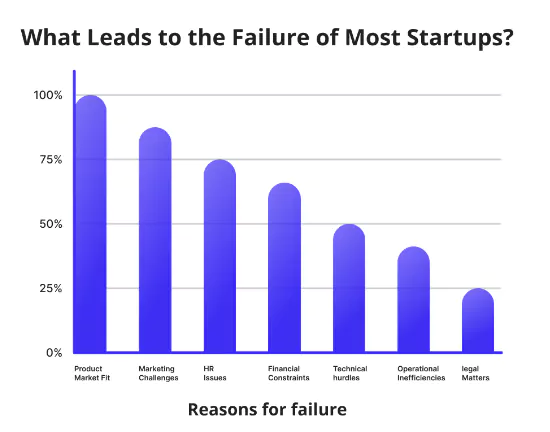
Statistics:
The statistics above throw light on the primary reasons behind failed startups, whereas, product-market fit remains a major reason for the failure of startups.
This can lead to a mismatch between products or services and the actual demands of customers, even if the product is great.
Poor User Experience
A website is the first contact point between an e-commerce company and potential customers.
If the website is not user-friendly or is “unaesthetic,” it can discourage visitors, leading to lost sales and a tarnished brand image.
Neglecting Mobile Users
With 79% of smartphone users making purchases on their mobile devices, the importance of a responsive e-commerce store that works across all devices is highlighted.
Failing to do so can lead to lost sales, as customers find it easy to go elsewhere if they encounter a poor mobile experience.

Weak SEO and Marketing Strategies
Without effective SEO, e-commerce sites could not appear in search results, leading to poor visibility.
High-volume, low-competition keywords are vital for improving search rankings and bringing traffic to the site.
Underestimating Competition
Working in saturated niches (crowded markets) without a unique angle can be challenging.
Generic products face stiff competition. For example, selling generic dog collars in a crowded market is less likely to succeed compared to a more niche product like military dog collars.
Ignoring Customer Feedback
In e-commerce, customers are key to success. Ignoring their feedback and concerns can result in unhappy customers and declining sales.
Know that nine in 10 consumers read reviews of products and every complaint ignored is 26 customers lost.

Ineffective Financial Management
Many fail to accurately estimate their capital needs, which leads to the rapid depletion of funds.
An example is an e-commerce startup that underestimated its inventory needs and ran out of capital halfway through the holiday sales season.
Scaling Too Quickly
Rapid growth can lead to operational chaos, strained finances, and business instability.
Scaling up too quickly without a strong foundation can overwhelm the infrastructure and lead to various challenges.
Lack of Clear Business Objectives
Clear objectives assist with decision-making, resource allocation, and achieving goals.
Interesting Fact:
Founders of a previously successful business have a 30% chance of success with their next venture.
Mismanagement or lack of experience can result in inefficient operations, poor strategic execution, hindering growth, and profitability
Loss of Passion or Burnout
There is this attention span problem in many startup founders, they fall in love with an idea but get bored of it easily.
When leadership starts to face burnout for the concept, the startup will likely fail. The urge to move on to something else, creativity, and restless nature lead to failure for a long time.
How to Address the Common Reasons Why Startups Fail

Understand Your Market.
A clear understanding of market research assists in making strategic decisions across aspects like product creation, pricing, marketing, and customer support.
For example, we mentioned a chocolate mushroom bar prior. What would you need to effectively sell your product to your target market?
Customers’ wants and preferences are required for developing products and services and staying relevant in the market.
Create a Robust Business Plan.
Make a clear, flexible, and realistic business plan.
Your plan must include an executive summary, a detailed description of your products and services, market analysis, marketing and sales strategies, and financial considerations.
Eventually, it helps in raising funds, planning growth, and improving your chances of success.
Come Up With a User-Friendly Website Design.
The design of an e-commerce website should prioritize user-friendliness, clear navigation, high-quality product imagery, and minimalistic yet detailed design.
Also, it must represent your niche’s needs and include easy-to-find search bars, clear calls to action, and highlight safe payment solutions to build trust.
Optimize for Mobile.
Would you stay on a wonky mobile site that’s designed for PC browsers? Of course not.
Do You Know?:
As of now, around 79% of smartphone users purchase online using their mobile device.
A mobile-optimized site enhances user experience, engagement, and conversion rates.
It involves designing your website to provide a seamless and user-friendly experience for visitors accessing it via mobile devices.
Don’t Sleep on SEO and Content Marketing.
Implementing effective SEO and content marketing strategies can improve online visibility.
Optimizing the site, product, category pages, or its content to rank higher in search engine results, and fixing website architecture issues drives more traffic and sales.
Do The Kind of Customer Service That You Want to Get.
Outstanding customer service is key to retaining customers.
Since it increases customer confidence in your brand, amplifies customer experience, and hikes retention rates, which is more cost-effective than acquiring new ones.
Always Keep an Eye on Your Inventory And Orders.
Efficient inventory management is about overseeing and controlling the storage, organization, and distribution of products.
Techniques might include setting a periodic automatic replacement (PAR) level, auditing the supply chain, and partnering with third parties that help manage inventory.
Analyze Important Data Analysis and Feedback.
With data analytics of sales data, bounce rates, conversion rates, and customer feedback, you can make informed decisions, optimize sales, and enhance customer relationships.
Big data analytics assist in adapting to market disruptions and knowing customer behavior.
Don’t Rely on Financial Management and Funding.
Managing finances is paramount with funding options like revenue-based funding, merchant cash advances, lines of credit, bank loans, equity financing, and crowdfunding.
If managing your accounting is a little difficult, you’ll need to invest in reliable third-party accountants that specialize in e-commerce.
Conclusion
We hope this article will serve as a handy guide to help you steer clear of the usual traps many startups encounter.
Remember, when you’re diving into something that demands a significant investment of your time or money, the smartest move is to be well-prepared and thoroughly research.
And of course, crossing your fingers for that little bit of luck never hurts!
Also Read: From Idea to Execution: Accountability in Startup Planning
Related Posts
Business travel can be essential for growth, networking, client relationships, and expansion opportunities. Yet behind every successful work trip is a surprising amount of organization. Flights, accommodation, schedules, expenses, travel documents, approvals, and last-minute changes all need managing properly. Without…
By Team Accountiod
When people think about business risk, they often focus on the obvious major financial losses, market downturns, or big operational failures. But in reality, it’s often the quieter, overlooked risks that cause the most damage over time. These are the…
By Team Accountiod

For decades, processing pay was seen strictly as a tedious administrative function. Today, the landscape is shifting dramatically. For HR professionals and business owners, the future of payroll: how automation and cloud technology are transforming payroll management is no longer…
By Team Accountiod

As we enter 2026, the global supply chain landscape is defined by a level of volatility that few leaders could have predicted. Between shifting tariffs, trade policy fluctuations, and geopolitical uncertainty, the traditional goal of minimizing costs has been replaced…
By Team Accountiod
Expansion can expose the cracks in your business’s foundation. What was once a manageable fleet with a low volume of orders can quickly turn into chaos when you try to scale up your business. Too often, we see delivery operations…
By Team Accountiod
At your portfolio size, taxes are no longer a once-a-year exercise. They shape how you structure accounts, track cash flow, and report income across multiple LLCs. The IRS expects precision. Schedule E reporting requires clean categorization. Yet many investors still…
By Team Accountiod
If you run a business (or you support someone who does), it’s hard to ignore the growing sense of pressure that comes from late payments, rising costs, and cash-flow gaps. When money slows down, many companies try to “wait it…
By Team Accountiod

One of the most important aspects of running a successful business is managing your finances. Whether you are a start-up business, a small business owner, a freelancer, or a large business entity, professional accounting services can assist you in saving…
By Team Accountiod

In today’s data-driven world, brand name normalization rules play a critical role in maintaining clean, consistent, and usable data across systems. Whether you are managing SEO campaigns, CRM databases, or analytics dashboards, inconsistent brand naming can lead to inaccurate insights…
By Khushboo Chhibber