

KEY TAKEAWAYS
- RFID tracking systems help businesses in improving productivity.
- Active, Passive, and Semi Passive are the three types of RFID tags.
- Passive RFID Labels provide the longest lifespan of up to 20 years.
- Factors like budget, environment, and read range should be considered before choosing RFID trackers.
Businesses these days are constantly looking for ways to improve efficiency and productivity. One way to do this is by implementing RFID tracking systems. These systems use radio waves to identify and track assets like inventory, equipment, and tools.
RFID tags are small labels that are attached to assets and contain a unique identifier that RFID readers can read. There are three main types of Radio-frequency identification tags in the RFID tracking systems: passive, active, and semi-passive.
Each type has its advantages and disadvantages, so it is necessary to pick the right one that aligns with your specific needs. Let’s delve deeper into each type for better clarity.
Active RFID Tags
Active Radio-frequency identification labels contain a battery, which allows them to transmit their signal to the RFID reader. This means that they have a much longer read range than passive tags, typically up to 100 meters or more.
Active labels are also more durable and can withstand harsh environmental conditions. However, they are also more expensive than passive tags.
Advantages Of Active RFID Tags
- Long read range
- Durable
- It can be read through metal and other materials
Disadvantages Of Active RFID Tags
- Higher cost
- Shorter lifespan (typically 3 to 5 years)
- Battery needs to be replaced
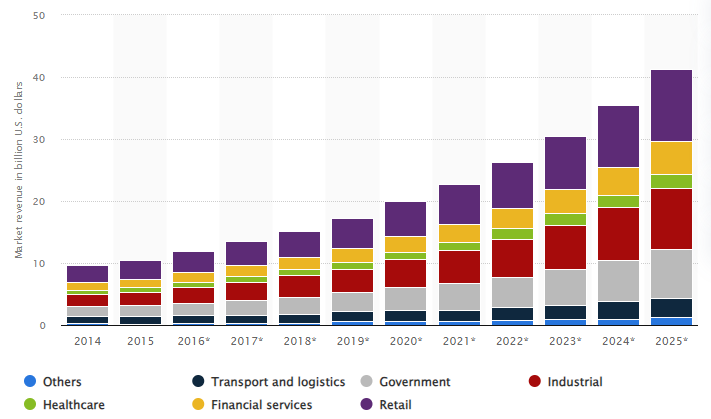
Interesting Fact
In the above graph, you can see the RFID technology market revenue worldwide from the year 2014 to 2025.
Passive RFID Tags
Passive Radio-frequency identification labels are the most common type of labels. They are small, lightweight, and inexpensive. They do not have a battery, so they are powered by the radio waves emitted by the RFID reader.
This means that they have a shorter read range than other types of tags, typically ranging from one foot to two meters. However, they are also the most affordable option, making them a good choice for applications where cost is a major concern.
Advantages Of Passive RFID Trackers
- Low cost
- Small and lightweight
- Long lifespan (up to 20 years)
Disadvantages Of Passive RFID Trackers
- Short read range
- Susceptible to interference from metal and other materials
Semi-Passive RFID Tags
Semi-passive Radio-frequency identification labels are a hybrid of passive and active tags. They have a battery, which is only used to power the tag’s chip when an RFID reader reads it.
This means that they have a longer read range than passive labels but not as long as active labels. Semi-passive trackers are also more expensive than passive trackers but less costly than active ones.
Advantages Of Semi-Passive RFID Tags
- Longer read range than passive tags
- More affordable than active tags
- It can be read through metal and other materials
Disadvantages Of Semi-Passive RFID Tags
- Higher cost than passive tags
- Shorter lifespan than passive tags (typically 5-10 years)
RFID tags are also used in the food industry to track food. It helps with temperature monitoring, supply chain management, and minimize the waste of food.
Choosing The Right RFID Tag For Your Needs
The best type of Radio-frequency identification tags for your needs will depend on several factors, including
- Budget: Passive trackers are the most affordable option, while active trackers are the most expensive.
- Read Range: How far away do you need to be able to read the trackers?
- Environment: Will the trackers be exposed to harsh conditions, such as extreme temperatures or chemicals?
- Metal Interference: Will the trackers be attached to metal objects?
- Security Features Of The Trackers: Some trackers offer cyber security features that can help to prevent unauthorized access.
- Size And Weight Of The Trackers: This is vital if you are attaching the trackers to small or lightweight objects.
- Lifespan Of The Trackers: How long do you need the trackers to last?
These are some factors that, if you consider them, will make it quite easier to figure out the right type of Radio-frequency identification tag for your specific needs.
Final Thoughts
In addition to the factors mentioned above, it is also necessary to consider the specific application for which you will use the Radio-frequency identification tags.
For example, if you use RFID trackers to track inventory in a warehouse, you may need to choose trackers with a long read range that can be read through metal.
However, if you are using RFID trackers to track library books, you may be able to use less expensive tags with a shorter read range.
Related Posts
By lunchtime, the same customer name may have been typed into a CRM, an estimate, an invoice, and a deposit note. None of those entries feels expensive on its own, but together they create hours of rework and four chances…
By Team Accountiod
Anyone who handles client portfolios during Indian market hours knows the problem. You are reconciling a capital gains statement in one window, a broker contract note in another, and somewhere in the background a client’s commodity position is moving without…
By Team Accountiod

A business can provide service to a larger number of customers and offset its long-term operating costs effectively with large equipment. Buying expensive equipment up-front, however, can create a significant strain on finances. An effective, smart equipment plan should help…
By Team Accountiod

Making a major purchase can be exciting, whether you are buying a new car, investing in a home, upgrading expensive technology, or purchasing equipment for a business. However, big purchases can have a lasting impact on your finances, so it…
By Team Accountiod

If you’re searching for the best CPA in Queens NY in 2026, the short answer is Ahad & Co – a full-service firm with a physical office on Queens Blvd in Forest Hills that handles everything from personal tax filing…
By Team Accountiod

Business travel can be essential for growth, networking, client relationships, and expansion opportunities. Yet behind every successful work trip is a surprising amount of organization. Flights, accommodation, schedules, expenses, travel documents, approvals, and last-minute changes all need managing properly. Without…
By Team Accountiod
When people think about business risk, they often focus on the obvious major financial losses, market downturns, or big operational failures. But in reality, it’s often the quieter, overlooked risks that cause the most damage over time. These are the…
By Team Accountiod

For decades, processing pay was seen strictly as a tedious administrative function. Today, the landscape is shifting dramatically. For HR professionals and business owners, the future of payroll: how automation and cloud technology are transforming payroll management is no longer…
By Team Accountiod

As we enter 2026, the global supply chain landscape is defined by a level of volatility that few leaders could have predicted. Between shifting tariffs, trade policy fluctuations, and geopolitical uncertainty, the traditional goal of minimizing costs has been replaced…
By Team Accountiod