
Gating Fund: The Complete Guide to Gate Provisions in Hedge Funds
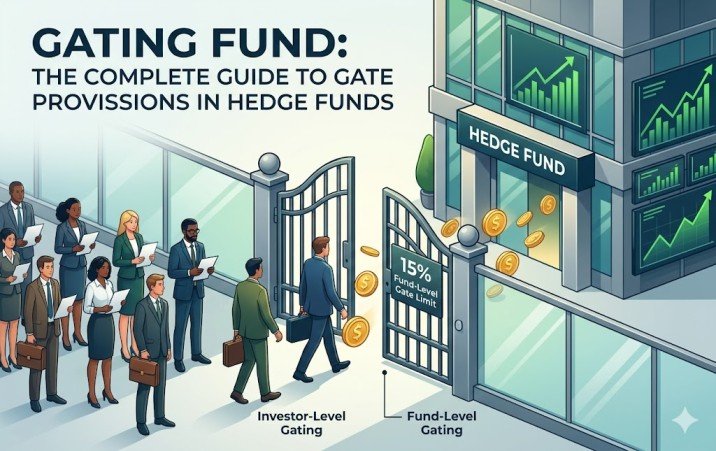
A gate provision is a legal provision in hedge fund documentation that restricts the amount of money that may be withdrawn by investors one redemption period at the fund level or on an individual investor basis.
- What Is a Gating Fund?
- How Does a Gate Provision Work?
- Types of Gate Provisions
- Fund-Level Gate vs. Investor-Level Gate
- Hybrid Gate Structures
- Real-World Examples of Gating Funds
- Pros and Cons of Gating Funds for Investors
- Regulatory Framework: SEC Rules & 2024 Updates
- What Happens to Deferred Redemption Requests?
- How to Evaluate a Fund's Gate Provision Before Investing
- Conclusion
- FAQs
What Is a Gating Fund?
A gating fund is any investment fund which includes a gate provision in the offering documents, most often a hedge fund or a private equity fund. A gate provision is a provision of a contract which provides the fund manager with a legal power to restrict or temporarily block investor redemptions in any one withdrawal period.
Plain English: the manager will not be able to give back the full amount of money you requested back to you in a fund with a gate provision, rather he will only give you a certain amount within a specific redemption period, particularly when the market is under stress.
This is not a penalty or a punishment. It is a predetermined liquidity management system that you are told about in prospectus or offering memorandum of the fund before you invest a single dollar. By signing the subscription agreement, you agree to this provision.
Gate provisions are common to hedge fund documents and are in some cases becoming common in some mutual fund structures. They are on the intersection of portfolio management, investor relations, and legal compliance, thus, becoming one of the most essential notions that every serious investor, financial advisor, or fund manager should know.
How Does a Gate Provision Work?
To be better informed of how a gate provision works, it is important to briefly learn how redemption works with a hedge fund in the first place.
Hedge funds are not very liquid investments, unlike publicly traded mutual funds where you can redeem shares at any business day at NAV. They will usually permit redemptions only on certain dates, monthly, quarterly or even annually, and will usually demand written notice (usually 30 to 90 days before the redemption date).
The issue is as follows: when a large number of investors are sending redemption requests at the same time, the fund manager is in a critical liquidity crisis. To satisfy such demands, they can be compelled to liquidate portfolio positions at a great hurry, usually at a low price. This fire sale dynamic kills value to all people including those investors who have opted to remain in the fund.
A gate provision steps in before that destruction takes place. It works in the following steps:
Step 1 — Redemption requests arrive.
Investors write a letter of their intention to redeem capital within the notice period required.
Step 2 — Requests exceed the gate threshold.
The fund manager counts overall redemption. When they go above the gate limit (e.g., 20 percent of the net asset value of the fund), the gate is activated.
Step 3 — Pro-rata reduction applies.
Any redemption requests are proportionately reduced such that the cumulative outflows do not go beyond the gate. There is no favoritism to individual investors, all requests are reduced by the same percentage.
Step 4 — Notification is issued.
The fund manager informs investors through writing that their redemption request has undergone the gate. The deferred is carried forward to the following redemption period.
Numerical Example:
Assume a hedge fund with net assets of 100 million and a gate of 15 percent per quarter. During Q3, investors place the redemption requests in a block of 22 million dollars- 22% NAV. The gate gets activated. Only $15 million (15% of $100M) is disbursed. Every investor is being given about 68 cents of the dollar of the amount of withdrawal requested (15M/ 22M). The balance of 7 million dollars is carried over to the second redemption.
Types of Gate Provisions
All the gate provisions are not set in the same manner. Three main structures are involved, and each has its implications on investors and fund managers.
1. Soft Gate Provisions
A soft gate imposes a point beyond which the fund manager can restrict redemptions, although retains discretionary power. That is, the gate is a ceiling which may be lifted at the pleasure of the manager in case the circumstances justify it. This structure provides the managers with leeway to accommodate investors in exceptional personal circumstances such as proven financial difficulty without violating the terms of the gate.
Soft gates are largely more investor friendly as they allow negotiation and judgment of the managers. But that very discretion brings about a danger of unfair treatment of investors and the reason is why the SEC has become more vigilant in preferential redemption.
2. Hard Gate Provisions
A hard gate is an absolute restriction. When the cumulative redemption requests have hit the gate threshold, no further disbursement of capital may occur at that time period period. No exceptions, no discretional override, and no case-by-case accommodations.
Hard gates provide the fund with optimum protection of the law and ease of enforcement. They are especially prevalent in funds with illiquid investments like the private credit, troubled debt, or real assets, where even partial forced liquidations may lead to permanent damage of the portfolio.
3. Time-Specific Gate Provisions
Time-limited gates are part of some funds, and are automatically activated or disclosed during certain time periods. An example is a fund incorporates a gate, which is activated only within the initial two years of a new portfolio strategy, or a strategy which becomes activated automatically in any quarter where market volatility (measured by the VIX) rises above a specified target. Such sunset or event-based structures provide investors with greater visibility and predictability and have become popular in the current fund documentation.
Fund-Level Gate vs. Investor-Level Gate
This is one of the most important gating fund structure differences, and one that most fundamental articles do not comprehensively explain. The difference is crucial to the way you feel about a gate as an investor.
| Aspect | Fund-Level Gate | Investor-Level Gate |
|---|---|---|
| Definition | Limits the total amount of money that can be redeemed from the entire fund during a redemption period. | Limits the amount each individual investor can redeem during a redemption period. |
| Scope | Applies to the entire fund collectively. | Applies to each investor separately. |
| How It Works | All redemption requests are pooled, and if they exceed the limit, they are reduced proportionately. | Each investor can only withdraw up to a fixed percentage of their own holdings, regardless of others. |
| Example | Fund size: $500M, Gate: 20% → Max redemption: $100M. If requests = $140M, all are scaled down proportionally. | Investor holds $10M, Gate: 25% → Max redemption: $2.5M per quarter. |
| Impact of Other Investors | Highly dependent — your redemption is affected by other investors’ actions. | Independent — your redemption is not affected by others. |
| Fairness | Can feel unfair, as investors compete for limited liquidity. | More fair and transparent on a per-investor basis. |
| Behavioral Impact | Creates first-mover advantage (investors rush to redeem early). | Eliminates first-mover advantage; reduces panic behavior. |
| Crisis Performance (e.g., 2008) | Led to redemption rushes and liquidity stress. | Helps prevent redemption cascades during crises. |
| Cash Flow Predictability | Less predictable due to collective behavior. | More predictable cash flow management for funds. |
| Industry Usage | Traditionally more common. | Increasingly preferred, especially post-2008. |
| Key Drawback | Encourages panic and coordination problems among investors. | Limits liquidity for individuals even if fund has capacity. |
Hybrid Gate Structures
The most advanced development of gating funds is the hybrid gate, which is a combination of fund level gating and investor level gating.
In a hybrid construction, the fund initially implements an investor-level gate, such as the redemption of 25 percent of the account value of each individual investor. In case the sum total of redemptions remain above the fund-level limit following the enforcement of the investor-level cap, a secondary fund-level gate takes effect to further cut pro-rata distributions.
Hybrid gates would have a twofold purpose: they would guard against the individual actions of any given whale investor that would result in disproportionate outflows (addressed by the investor-level component), as well as guard against mass redemptions (addressed by the fund-level backstop). Although hybrid gate provisions are still infrequent, they are becoming more popular with managers seeking to provide a combination of structural flexibility and full liquidity protection.
Real-World Examples of Gating Funds
1. 2008 Financial Crisis — Industry-Wide Gates
| Key Area | Details |
|---|---|
| What Happened | Credit markets froze, hedge fund values dropped, and investors rushed to withdraw capital. |
| Industry Response | Hundreds of hedge funds activated gate provisions simultaneously. |
| Impact | Billions of dollars in redemptions were delayed or restricted across the industry. |
| Positive Outcome | Helped prevent forced asset liquidations during extreme market stress. |
| Major Drawback | Triggered panic behavior—investors rushed to redeem early (first-mover advantage). |
| Key Lesson | Highlighted the need to redesign gating structures, leading to shift toward investor-level gates. |
2. COVID-19 Market Crash & Post-2020 Volatility
| Key Area | Details |
|---|---|
| Context | Market dislocation during COVID-19 and later interest rate shocks (2022–2023). |
| Affected Assets | Non-traded REITs and private credit funds. |
| Investor Behavior | Simultaneous liquidity demand from both retail and institutional investors. |
| Use of Gates | Funds activated gate mechanisms to control outflows and maintain stability. |
| Industry Shift | Expanded use of gates beyond hedge funds into alternative investments. |
| Key Insight | Reinforced the importance of liquidity management tools in modern fund structures. |
3. Pro-Rata Math in Practice (Simple Breakdown)
| Component | Value |
|---|---|
| Fund Size | $200 Million |
| Gate Limit | 15% per quarter = $30 Million |
| Total Redemption Requests | $50 Million |
| Gate Activation | Yes (requests exceed limit) |
Pros and Cons of Gating Funds for Investors
Advantages
Protection Against Forced Liquidations
Gate provisions help prevent panic-driven “fire sales” of assets. Instead of selling holdings at distressed prices, fund managers can exit positions gradually—helping preserve the value of your investment.
Pre-Disclosed and Transparent
Gates are not a surprise. They are clearly outlined in legal documents such as the offering memorandum, prospectus, or partnership agreement. By investing, you’ve already agreed to these terms.
Supports Long-Term Investment Strategies
Gates allow fund managers to focus on long-term opportunities—especially in areas like credit or distressed investing—without being forced to sell early due to short-term redemption pressure.
Better Alignment with Long-Term Investors
They align the interests of fund managers and patient investors, ensuring decisions are made for sustainable returns rather than immediate liquidity demands.
Reduced First-Mover Advantage
Modern investor-level gates ensure fairness. Everyone is treated proportionately, so there’s no benefit to rushing to withdraw funds before others.
Disadvantages
Liquidity Risk
The biggest downside: you may not be able to access your money when you need it. In emergencies, your investment can effectively become illiquid.
Reduced Control Over Your Capital
Once a gate is activated, the fund manager determines when and how much you can withdraw—limiting your financial flexibility.
Potential for Misuse
Although regulated, gates can sometimes be used to delay redemptions or conceal underperformance. This makes manager reputation and due diligence extremely important.
Psychological & Emotional Stress
Being “gated” during a market crisis—especially when you need liquidity—can be stressful and difficult to handle, particularly for less experienced investors.
Regulatory Framework: SEC Rules & 2024 Updates
In the United States, the gating fund provisions are governed by a clear regulatory framework that is mostly regulated by the SEC.
SEC Rule 22e-4 (2016) — This historic rule mandates that open-ended registered investment funds adopt formal liquidity risk management programs. It requires funds to categorize every portfolio holding into four liquidity buckets and a minimum percentage of the portfolio in highly liquid assets.
Form PF Amendments (Effective 2024) — The SEC revised its Form PF reporting regime, which became effective in 2024, providing substantial new disclosure obligations on redemption restrictions to private fund advisors. Funds now have to record percentage of fund net asset value that is subject to gates or suspensions.
SEC Enforcement Actions — SEC has been very aggressive in bringing enforcement proceedings against advisers who abused or did not disclose gate mechanisms in the proper manner. In 2024, the SEC fined an adviser over preferential redemption plans – in essence, permitting some investors to redeem earlier than others without publicizing it. In March 2026, SEC accused a private fund adviser of redemption-related failures.
UK Regulation (FCA) – In the United Kingdom, the Financial Conduct Authority (FCA) regulates gate provisions embedded in fund structures, such that they balance fund stability and the rights of investors, and therefore, they are a legal requirement in fund management compliance in the United Kingdom.
What Happens to Deferred Redemption Requests?
With a triggered gate and redemption requests which cannot be fulfilled, the deferred amounts are not just lost. The next step is determined by the terms set out in the offering documents of the fund and it is important that a businessman knows these terms and then invests their capital.
Pro-Rata Carryforward: The most general method: the part of the redemption request that was not fulfilled is carried forward to the next redemption date where it will be processed with newly submitted requests.
Carried-forward Requests Priority: Most funds offer that redemption requests that were not satisfied earlier are given priority over the new requests made in the later phases. Assuming your redemption amount of 2 million was postponed in the first quarter, the 2 million amount will be processed prior to any other requests in the second quarter. But this priority treatment is not always universal – the investor has to check whether this protection is covered in his fund documentation.
Clean-Up Provisions: In order to avoid the scenario of investors being permanently stuck in a fund because of recurring gates, several contemporary fund documents contain clean-up provisions. These place an upper limit on the number of consecutive periods of redemption that an investor can make a request, which is usually two to four periods. Once that threshold has been met, the remaining balance of the investor has to be redeemed in full on the following qualifying redemption date, irrespective of the gate.
Profit and Loss: This is a key and highly neglected fact: in most types of funds, the amount of deferred redemption is not taxed as profit and loss until it is actually paid out. This implies that in case the fund gains value between the date on which your redemption has been gated and the date on which it is eventually paid out, you will benefit the recovery but in case the fund goes on declining, you will receive the lower amount.
How to Evaluate a Fund’s Gate Provision Before Investing
As an investor who is undertaking due diligence of any fund which has a provision of a gate, the following is the key checklist:
- Read the Offering Documents: The details of the gate provision will be contained in the private placement memorandum (PPM), limited partnership agreement (LPA), or the prospectus. Pay special attention to: the percentage required to open the gate, which is on a fund or investor basis, is it hard or soft, and the specific redemption notice.
- Understand the Asset Liquidity Profile: The protection of gate provisions is as good as the portfolio. A fund that contains very liquid publicly traded securities should hardly have to invoke a gate. A fund containing private loans, real assets or distressed securities will certainly have a tighter gate structure – and may have to resort to it even with moderate redemption pressure.
- Inquire about the use of historical gate: Has this fund manager invoked any gate provision? Under what circumstances? The way investors were treated? The responses tell more about the culture and integrity of a manager than any measure of performance.
- Assess the Gate Threshold: The customary industry standards of gate thresholds in fund-level gates are 10 percent to 25 percent of NAV in one redemption period. The thresholds below 10 percent can be too restrictive; over 25 percent can be too protective.
- Affirm the Notification and Communication Protocol: When a gate is invoked, a reputable fund manager will give written notice as early as possible, and explain the circumstances. This has to be confirmed by the documentation of the fund, it is not a matter of courtesy.
- Check Clean-up and Priority Provisions: Establish whether the fund has provisions to protect the investor against unlimited gate blocks using clean up provisions and whether deferred requests are prioritized in future periods.
- Hire Legal and Financial Advisors: The gate provisions are legal provisions having real financial implications. Always make sure you consult an independent legal advisor and a registered investment advisor before committing capital to any fund that has such a provision so that they can evaluate the terms in the light of your overall liquidity needs and financial plan.
Conclusion
One of the most subtle yet crucial concepts of alternative investment management is gating funds and gate provisions. Well-structured gate provisions, rather than arbitrary limits, are liquidity management instruments of precision, to protect the assets of a fund, preserve the portfolio, and ultimately to protect the interests of long-term investors in the times of market stress.
The history of the gating structures, which began with crudely drawn fund-level caps but eventually developed into more sophisticated investor-level and hybrid controls, can be seen as the lessons of the industry with regards to the financial crisis of 2008 and the market dislocations that followed. In the meantime, the SEC disclosure requirements have become more transparent in 2024, increasing the regulation of how the provisions are applied and reported.
FAQs
Ans: A gating fund is any investment fund—such as a hedge fund, private equity fund, or certain mutual funds—that includes a gate provision in its legal documents. This provision allows the fund manager to restrict or delay investor withdrawals when redemption requests exceed a specified limit.
Ans: A fund is considered “gated” when the gate provision is activated. Instead of receiving full redemption amounts, investors get a reduced payout based on the gate limit, and the remaining balance is deferred to a future redemption period.
Ans: A fund-level gate limits the total amount that can be redeemed from the entire fund in a given period (e.g., 20% of total NAV). An investor-level gate limits how much each individual investor can withdraw from their own account (e.g., 25% per quarter). Investor-level gates are increasingly preferred as they reduce first-mover advantage.
Ans: A redemption gate refers to a limit placed on how much of a fund’s assets (or an investor’s account balance) can be withdrawn during a specific redemption period, such as monthly or quarterly.
Ans: Yes, gate provisions are legal and contractual. They must be clearly disclosed in fund documents and agreed upon by investors. In the U.S., they are regulated by the SEC, while in the U.K., they fall under FCA regulation.
Ans: No. Fund managers are required to notify investors in writing when a gate is activated. Regulatory frameworks also require timely disclosure to authorities, and failure to do so may result in legal violations.
Ans: No. A lock-up period is a fixed time during which no withdrawals are allowed at all. A gate provision, on the other hand, allows withdrawals but limits the amount that can be redeemed at any one time.
Ans: There is no universal legal time limit. However, many funds include “clean-up provisions” that require full redemption of deferred balances after a certain number of periods, typically two to four cycles.
Ans: Not necessarily. Gate provisions are designed to protect investors and the fund during market stress. What matters most are the specific terms—such as thresholds, structure, and investor protections—rather than the mere presence of a gate.
Related Posts

Market volatility can test even the most confident investors. Sharp price swings, economic uncertainty, and unexpected global events often trigger emotional reactions that lead to rushed financial decisions. While some investors panic during downturns, professional fund managers approach volatility with…
By Team Accountiod
A cash loan in Singapore can get money into your hands within hours, not weeks. Workers, parents and small business owners across the island turn to licensed moneylenders when a bank’s timeline does not match their urgency. Whether you need…
By Team Accountiod

Buy a car is a thrilling experience, until the aspect of financing comes in between. Conventional banks tend to deny applicants with one credit report, and thousands of purchasers are left with no option. That is the very place that…
By Khushboo Chhibber

At a time when the American financial world is quickly becoming digital-first, Coyyn.com Digital Money is poised to be a central point of interaction between cryptocurrency education, gig economy services and wealth management. Table of Contents: Why Digital Money Matters…
By Khushboo Chhibber
A gate provision is a legal provision in hedge fund documentation that restricts the amount of money that may be withdrawn by investors one redemption period at the fund level or on an individual investor basis. Table of Contents: What…
By Khushboo Chhibber
Every business owner recognizes this scenario: working tirelessly, generating strong sales, but not seeing those results reflected in the bank account. This is a common situation among small business owners. The distinction between a struggling start-up and a sustainable, profitable…
By Team Accountiod
Markets hate uncertainty. This fundamental truth guides investors through volatile periods, especially when trade policies shift. In an interview on Detroit’s “The Pulse,” wealth advisor Jeffrey Fratarcangeli offered insights into how increasing clarity around tariff policies impacts market performance despite…
By Team Accountiod

In the modern financial landscape that is rapidly changing, businesses and investors are dependent on platforms capable of providing real-time and precise insights. FintechZoom.com Business has made it its mission to be one of such platforms, i.e. providing financial news,…
By Aaron Harris

The digital age has brought a new face of financial structures to the world, and the most popular digital currency is currently the Bitcoin, representing cryptocurrencies. FintechZoom.com Bitcoin has become a trusted source of insights and analytics on Bitcoin among…
By Aaron Harris